Display of colours by a CD can be understood in terms of the working of a plane optical reflection grating.It is a flat optical device whose surface is ruled(striped)with a set of closely and uniformly spaced lines,such that light is reflected by the lines.When light falls on a plane reflection grating,it is scattered in all directions by each of its reflecting stripes.
These waves from individual gaps are termed wavelets.When we look at the grating from a distance,wavelets from different stripes travel different distances to reach the retina of our eye.Their crests (or troughs)do not reach a given point at the same time.
Usually crests of some wavelets and troughs of others reach a point.Troughs have the property of partially or totally nullifying crest sand vice versa,depending on their strengths.In this case the wavelets are said to interfere destructively.
But for certain orientations of the grating,it so happens that troughs(or crests)of all wavelets reach a point together,enhancing the effect of each other.The wavelets are then said to interfere constructively.Ordinarily,when light falls on a grating,wavelets corresponding to all wavelengths(or colours)are sent out by the reflecting gaps.
Since the condition of constructive interference hold good only for some particular wavelength,light intensity at the receiving point is exceptionally high only for that wavelength.Light from the grating from the related direction is thus rich in the corresponding colour.Similarly light from slightly different direction is rich in a another colour.A CD has a data recording track,which spirals from its outer periphery to the inner circular boundary.This takes many tens of thousand rounds about the Cd's centre.
When examined along a radius of the CD,it is found to have a structure similar to that of a reflection grating-set of almost straight tracks running perpendicular to the radius and separated by gaps Therefore,like a grating the CD also displays colour.
Jan 17, 2009


Jan 16, 2009
The Christian Calendar
What is the Julian calendar?

The Julian calendar was introduced by Julius Caesar (sculpture at right) in 45 B.C.E. Author David Duncan says the Julian calendar was born of Caesar’s tryst with Cleopatra.
Before the Julian calendar was introduced, priests in the Roman Empire exploited the calendar for political ends, inserting days and even months into the calendar to keep the politicians they favored in office. Tired of the chaos that this undependable system eventually gave rise to, Julius Caesar finally set out to put the long-abused calendar back on track.
It was in common use until the late 1500s, when countries started changing
to the Gregorian calendar (see the modern year). However,some countries (for example, Greece and Russia) used it into the early 1900s,and the Orthodox church in Russia still uses it, as do some other Orthodox churches.
In the Julian calendar, the tropical year is approximated as
365¼ days = 365.25 days. This gives an error of 1 day in approximately 128 years.
The approximation 365¼ is achieved by having 1 leap year every 4 years.
What years are leap years?
The Julian calendar has 1 leap year every 4 years:Every year divisible by 4 is a leap year.However, the 4-year rule was not followed in the first years after the
introduction of the Julian calendar in 45 B.C.E. Due to a counting error, every 3rd year was a leap year in the first years of this calendar’s existence. The leap years were:
45 B.C.E., 42 B.C.E., 39 B.C.E., 36 B.C.E., 33 B.C.E., 30 B.C.E., 27 B.C.E.,
24 B.C.E., 21 B.C.E., 18 B.C.E., 15 B.C.E., 12 B.C.E., 9 B.C.E.,
C.E. 8, C.E. 12, and every 4th year from then on.
Authorities disagree about whether 45 B.C.E. was a leap year or not.There were no leap years between 9 B.C.E. and C.E. 8 (or, according to some authorities, between 12 B.C.E. and C.E. 4). This period without leap years was decreed by emperor Augustus in order to make up for the surplus of leap years introduced previously, and it earned him a place in the calendar as the 8th month was named after him.
It is a curious fact that although the method of reckoning years after the
(official) birthyear of Christ was not introduced until the 6th century, by some stroke of luck the Julian leap years coincide with years of our Lord that are divisible by 4.
What consequences did the use of the Julian calendar have?
The Julian calendar introduces an error of 1 day every 128 years. So every 128 years the tropical year shifts one day backwards with respect to the calendar. Furthermore, the method for calculating the dates for Easter was inaccurate and needed to be refined.In order to remedy this, two steps were necessary: 1) The Julian calendar had to be replaced by something more adequate. 2) The extra days
that the Julian calendar had inserted had to be dropped.
The solution to problem 1 was the Gregorian calendar described in the section about the modern year.The solution to problem 2 depended on the fact that it was felt that 21 March was the proper day for vernal equinox (because 21 March was
the date for vernal equinox during the Council of Nicaea in C.E. 325). The Gregorian calendar was therefore calibrated to make that day vernal equinox.By 1582 vernal equinox had moved (1582-325)/128 days = approximately 10 days backwards. So 10 days had to be dropped.
What is the Roman calendar?
Before Julius Caesar introduced the Julian calendar in 45 B.C.E., the Roman
calendar was a mess, and much of our so-called "knowledge" about it seems to be little more than guesswork.Originally, the year started on 1 March and consisted of only 304 days or 10 months (Martius, Aprilis, Maius, Junius, Quintilis, Sextilis,
September, October, November, and December). These 304 days were followed by an unnamed and unnumbered winter period. The Roman king Numa Pompilius (c. 715-673 B.C.E., although his historicity is disputed) allegedly introduced February and January (in that order) between December and March, increasing the length of the year to 354 or 355 days. In 450 B.C.E., February was moved to its current position between January and March.In order to make up for the lack of days in a year, an extra month, Intercalaris or Mercedonius, (allegedly with 22 or 23 days though some
authorities dispute this) was introduced in some years. In an 8 year period the
length of the years were:
1: 12 months or 355 days
2: 13 months or 377 days
3: 12 months or 355 days
4: 13 months or 378 days
5: 12 months or 355 days
6: 13 months or 377 days
7: 12 months or 355 days
8: 13 months or 378 days
A total of 2930 days corresponding to a year of 366¼ days. This year was discovered to be too long, and therefore 7 days were later dropped from the 8th year, yielding 365.375 days per year.This is all theory. In practice it was the duty of the priesthood to keep track of the calendars, but they failed miserably, partly due to ignorance, partly because they were bribed to make certain years long and
other years short. Furthermore, leap years were considered unlucky and were therefore avoided in time of crisis, such as the Second Punic War.
In order to clean up this mess, Julius Caesar made his famous calendar reform in 45 B.C.E. We can make an educated guess about the length of the months in the years 47 and 46 B.C.E.:
47 B.C.E. 46 B.C.E.
January 29 29
February 28 24
Intercalaris 27
March 31 31
April 29 29
May 31 31
June 29 29
Quintilis 31 31
Sextilis 29 29
September 29 29
October 31 31
November 29 29
Undecember 33
Duodecember 34
December 29 29
Total 355 445
The length of the months from 45 B.C.E. onward were the same as the ones we know today.Occasionally one reads the following story:
"Julius Caesar made all odd numbered months 31 days long, and all even
numbered months 30 days long (with February having 29 days
in non-leap years). In 44 B.C.E. Quintilis was renamed ‘Julius’ (July) in honor
of Julius Caesar, and in 8 B.C.E. Sextilis became ‘Augustus’ in
honor of emperor Augustus. When Augustus had a month named after him,
he wanted his month to be a full 31 days long, so he removed
a day from February and shifted the length of the other months so that
August would have 31 days."
This story, however, has no basis in actual fact. It is a fabrication, possibly
invented by the English-French scholar Johannes de Sacrobosco in the 13th century.
How did the Romans number days?
The Romans did not number the days sequentially from 1. Instead they had three fixed points in each month:"Kalendae"(or "Calendae"), which was the first day of the month."Idus,"which was the 13th day of January, February, April, June, August, September, November, and December, or the 15th day of March, May, July, or October.
"Nonae,"which was the 9th day before Idus (counting Idus itself as the 1st day).
The days between Kalendae and Nonae were called "the 5th day before Nonae," "the 4th day before Nonae," "the 3rd day before Nonae," and "the day before Nonae." (There was no "2nd day before Nonae." This was because of the inclusive way of counting used by the Romans: To them, Nonae itself was the first day, and thus "the 2nd day before" and "the day before" would mean the same thing.)
Similarly, the days between Nonae and Idus were called "the Xth day before Idus," and the days after Idus were called "the Xth day before Kalendae (of the next month)."
Julius Caesar decreed that in leap years the "6th day before Kalendae of
March" should be doubled. So in contrast to our present system, in which we introduce an extra date (29 February), the Romans had the same date twice in leap years. The doubling of the 6th day before Kalendae of March is the origin of the word bissextile. If we create a list of equivalence between the Roman days and our current days of February in a leap year, we get the following:
7th day before Kalendae of March 23 February
6th day before Kalendae of March 24 February
6th day before Kalendae of March 25 February
5th day before Kalendae of March 26 February
4th day before Kalendae of March 27 February
3rd day before Kalendae of March 28 February
The day before Kalendae of March 29 February
Kalendae of March 1 March

You can see that the extra 6th day (going backwards) falls on what is today
24 February. For this reason 24 February is still today
considered the "extra day" in leap years. However, at certain times in history,
the second 6th day (25 Feb) has been considered the leap day.
Why did Caesar choose to double the 6th day before Kalendae of March? It
appears that the leap month Intercalaris/Mercedonius of the
pre-reform calendar was not placed after February, but inside it, namely
between the 7th and 6th day before Kalendae of March. It was
therefore natural to have the leap day in the same position.
What is the proleptic calendar?
The Julian calendar was introduced in 45 BC, but when historians date events
prior to that year, they normally extend the Julian calendar
backward in time. This extended calendar is known as the "Julian Proleptic
Calendar".
Similarly, it is possible to extend the Gregorian calendar backward in time
before 1582. However, this "Gregorian Proleptic Calendar" is not
commonly used.
If someone refers to, for example, 15 March 429 BC, they are probably using
the Julian proleptic calendar.
In the Julian proleptic calendar, year X BC is a leap year, if X-1 is divisible by
4. This is the natural extension of the Julian leap year rules.
What is Easter?
In the Christian world, Easter (and the days immediately preceding it) is the
celebration of the death and resurrection of Jesus in
(approximately) C.E. 30.
→ See additional information on Easter.
What is the Indiction?
The Indiction was used in the middle ages to specify the position of a year in
a 15 year taxation cycle. It was introduced by emperor
Constantine the Great on 1 September 312 and ceased to be used in 1806.
The Indiction may be calculated thus:
Indiction = (year + 2) mod 15 + 1
The Indiction has no astronomical significance.
The Indiction did not always follow the calendar year. Three different
Indictions may be identified:
* The Pontifical or Roman Indiction, which started on New Year’s Day
(being either 25 December, 1 January, or 25 March).
* The Greek or Constantinopolitan Indiction, which started on 1
September.
* The Imperial Indiction or Indiction of Constantine, which started on 24
September.
What is the Julian Period?
The Julian period (and the Julian day number) must not be confused with the
Julian calendar.
The French scholar Joseph Justus Scaliger (1540-1609) was interested in
assigning a positive number to every year without having to worry
about B.C.E. / C.E. He invented what is today known as the Julian Period.
The Julian Period probably takes its name from the Julian calendar, although it
has been claimed that it is named after Scaliger’s father, the
Italian scholar Julius Caesar Scaliger (1484-1558).
Scaliger’s Julian period starts on 1 January 4713 B.C.E. (Julian calendar) and
lasts for 7980 years. C.E. 2000 is thus year 6713 in the Julian
period. After 7980 years the number starts from 1 again.
Why 4713 B.C.E. and why 7980 years? Well, in 4713 B.C.E. the Indiction (see
above), the Golden Number (see section on Easter) and the
Solar Number (see above) were all 1. The next times this happens is 15 x 19 x
28 = 7980 years later, in C.E. 3268.
Astronomers have used the Julian period to assign a unique number to every
day since 1 January 4713 B.C.E. This is the so-called Julian Day
(JD). JD 0 designates the 24 hours from noon UTC on 1 January 4713 B.C.E. to
noon UTC on 2 January 4713 B.C.E.
This means that at noon UTC on 1 January C.E. 2000, JD 2,451,545 will start.
This can be calculated thus:
From 4713 B.C.E. to C.E. 2000 there are 6712 years.
In the Julian calendar, years have 365.25 days, so 6712 years correspond
to 6712 x 365.25=2,451,558 days. Subtract from this the 13
days that the Gregorian calendar is ahead of the Julian calendar, and you get
2,451,545.
Often fractions of Julian day numbers are used, so that 1 January C.E. 2000 at
15:00 UTC is referred to as JD 2,451,545.125.
Note that some people use the term "Julian day number" to refer to any
numbering of days. NASA, for example, use the term to denote the
number of days since 1 January of the current year, counting 1 January as day
1.
Is there a formula for calculating the Julian day number?
Try this one (the divisions are integer divisions, in which remainders are
discarded):
a = (14-month)/12
y = year+4800-a
m = month + 12*a - 3
For a date in the Gregorian calendar:
JD = day + (153*m+2)/5 + y*365 + y/4 - y/100 + y/400 - 32045
For a date in the Julian calendar:
JD = day + (153*m+2)/5 + y*365 + y/4 - 32083
JD is the Julian day number that starts at noon UTC on the specified date.
The algorithm works fine for AD dates. If you want to use it for BC dates, you
must first convert the BC year to a negative year (e.g., 10 BC
= -9). The algorithm works correctly for all dates after 4800 BC, i.e., at least
for all positive Julian day numbers.
To convert the other way (i.e., to convert a Julian day number, JD, to a day,
month, and year) these formulas can be used (again, the
divisions are integer divisions):
For the Gregorian calendar:
a = JD + 32044
b = (4*a+3)/146097
c = a - (b*146097)/4
For the Julian calendar:
b = 0
c = JD + 32082
Then, for both calendars:
d = (4*c+3)/1461
e = c - (1461*d)/4
m = (5*e+2)/153
day = e - (153*m+2)/5 + 1
month = m + 3 - 12*(m/10)
year = b*100 + d - 4800 + m/10
What is the modified Julian day number?
Sometimes a modified Julian day number (MJD) is used which is 2,400,000.5
less than the Julian day number. This brings the numbers into
a more manageable numeric range and makes the day numbers change at
midnight UTC rather than noon.
MJD 0 thus started on 17 Nov 1858 (Gregorian) at 00:00:00 UTC.
What is the Lilian day number?
The Lilian day number is similar to the Julian day number, except that Lilian
day number 1 started at midnight on the first day of the
Gregorian calendar, that is, 15 October 1582.
The Lilian day number was invented by Bruce G. Ohms of IBM in 1986. It is
named after Aloysius Lilius.
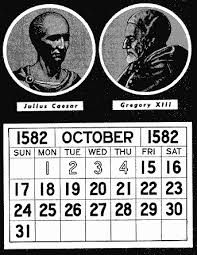
The Julian calendar was introduced by Julius Caesar (sculpture at right) in 45 B.C.E. Author David Duncan says the Julian calendar was born of Caesar’s tryst with Cleopatra.
Before the Julian calendar was introduced, priests in the Roman Empire exploited the calendar for political ends, inserting days and even months into the calendar to keep the politicians they favored in office. Tired of the chaos that this undependable system eventually gave rise to, Julius Caesar finally set out to put the long-abused calendar back on track.
It was in common use until the late 1500s, when countries started changing
to the Gregorian calendar (see the modern year). However,some countries (for example, Greece and Russia) used it into the early 1900s,and the Orthodox church in Russia still uses it, as do some other Orthodox churches.
In the Julian calendar, the tropical year is approximated as
365¼ days = 365.25 days. This gives an error of 1 day in approximately 128 years.
The approximation 365¼ is achieved by having 1 leap year every 4 years.
What years are leap years?
The Julian calendar has 1 leap year every 4 years:Every year divisible by 4 is a leap year.However, the 4-year rule was not followed in the first years after the
introduction of the Julian calendar in 45 B.C.E. Due to a counting error, every 3rd year was a leap year in the first years of this calendar’s existence. The leap years were:
45 B.C.E., 42 B.C.E., 39 B.C.E., 36 B.C.E., 33 B.C.E., 30 B.C.E., 27 B.C.E.,
24 B.C.E., 21 B.C.E., 18 B.C.E., 15 B.C.E., 12 B.C.E., 9 B.C.E.,
C.E. 8, C.E. 12, and every 4th year from then on.
Authorities disagree about whether 45 B.C.E. was a leap year or not.There were no leap years between 9 B.C.E. and C.E. 8 (or, according to some authorities, between 12 B.C.E. and C.E. 4). This period without leap years was decreed by emperor Augustus in order to make up for the surplus of leap years introduced previously, and it earned him a place in the calendar as the 8th month was named after him.
It is a curious fact that although the method of reckoning years after the
(official) birthyear of Christ was not introduced until the 6th century, by some stroke of luck the Julian leap years coincide with years of our Lord that are divisible by 4.
What consequences did the use of the Julian calendar have?
The Julian calendar introduces an error of 1 day every 128 years. So every 128 years the tropical year shifts one day backwards with respect to the calendar. Furthermore, the method for calculating the dates for Easter was inaccurate and needed to be refined.In order to remedy this, two steps were necessary: 1) The Julian calendar had to be replaced by something more adequate. 2) The extra days
that the Julian calendar had inserted had to be dropped.
The solution to problem 1 was the Gregorian calendar described in the section about the modern year.The solution to problem 2 depended on the fact that it was felt that 21 March was the proper day for vernal equinox (because 21 March was
the date for vernal equinox during the Council of Nicaea in C.E. 325). The Gregorian calendar was therefore calibrated to make that day vernal equinox.By 1582 vernal equinox had moved (1582-325)/128 days = approximately 10 days backwards. So 10 days had to be dropped.
What is the Roman calendar?
Before Julius Caesar introduced the Julian calendar in 45 B.C.E., the Roman
calendar was a mess, and much of our so-called "knowledge" about it seems to be little more than guesswork.Originally, the year started on 1 March and consisted of only 304 days or 10 months (Martius, Aprilis, Maius, Junius, Quintilis, Sextilis,
September, October, November, and December). These 304 days were followed by an unnamed and unnumbered winter period. The Roman king Numa Pompilius (c. 715-673 B.C.E., although his historicity is disputed) allegedly introduced February and January (in that order) between December and March, increasing the length of the year to 354 or 355 days. In 450 B.C.E., February was moved to its current position between January and March.In order to make up for the lack of days in a year, an extra month, Intercalaris or Mercedonius, (allegedly with 22 or 23 days though some
authorities dispute this) was introduced in some years. In an 8 year period the
length of the years were:
1: 12 months or 355 days
2: 13 months or 377 days
3: 12 months or 355 days
4: 13 months or 378 days
5: 12 months or 355 days
6: 13 months or 377 days
7: 12 months or 355 days
8: 13 months or 378 days
A total of 2930 days corresponding to a year of 366¼ days. This year was discovered to be too long, and therefore 7 days were later dropped from the 8th year, yielding 365.375 days per year.This is all theory. In practice it was the duty of the priesthood to keep track of the calendars, but they failed miserably, partly due to ignorance, partly because they were bribed to make certain years long and
other years short. Furthermore, leap years were considered unlucky and were therefore avoided in time of crisis, such as the Second Punic War.
In order to clean up this mess, Julius Caesar made his famous calendar reform in 45 B.C.E. We can make an educated guess about the length of the months in the years 47 and 46 B.C.E.:
47 B.C.E. 46 B.C.E.
January 29 29
February 28 24
Intercalaris 27
March 31 31
April 29 29
May 31 31
June 29 29
Quintilis 31 31
Sextilis 29 29
September 29 29
October 31 31
November 29 29
Undecember 33
Duodecember 34
December 29 29
Total 355 445
The length of the months from 45 B.C.E. onward were the same as the ones we know today.Occasionally one reads the following story:
"Julius Caesar made all odd numbered months 31 days long, and all even
numbered months 30 days long (with February having 29 days
in non-leap years). In 44 B.C.E. Quintilis was renamed ‘Julius’ (July) in honor
of Julius Caesar, and in 8 B.C.E. Sextilis became ‘Augustus’ in
honor of emperor Augustus. When Augustus had a month named after him,
he wanted his month to be a full 31 days long, so he removed
a day from February and shifted the length of the other months so that
August would have 31 days."
This story, however, has no basis in actual fact. It is a fabrication, possibly
invented by the English-French scholar Johannes de Sacrobosco in the 13th century.
How did the Romans number days?
The Romans did not number the days sequentially from 1. Instead they had three fixed points in each month:"Kalendae"(or "Calendae"), which was the first day of the month."Idus,"which was the 13th day of January, February, April, June, August, September, November, and December, or the 15th day of March, May, July, or October.
"Nonae,"which was the 9th day before Idus (counting Idus itself as the 1st day).
The days between Kalendae and Nonae were called "the 5th day before Nonae," "the 4th day before Nonae," "the 3rd day before Nonae," and "the day before Nonae." (There was no "2nd day before Nonae." This was because of the inclusive way of counting used by the Romans: To them, Nonae itself was the first day, and thus "the 2nd day before" and "the day before" would mean the same thing.)
Similarly, the days between Nonae and Idus were called "the Xth day before Idus," and the days after Idus were called "the Xth day before Kalendae (of the next month)."
Julius Caesar decreed that in leap years the "6th day before Kalendae of
March" should be doubled. So in contrast to our present system, in which we introduce an extra date (29 February), the Romans had the same date twice in leap years. The doubling of the 6th day before Kalendae of March is the origin of the word bissextile. If we create a list of equivalence between the Roman days and our current days of February in a leap year, we get the following:
7th day before Kalendae of March 23 February
6th day before Kalendae of March 24 February
6th day before Kalendae of March 25 February
5th day before Kalendae of March 26 February
4th day before Kalendae of March 27 February
3rd day before Kalendae of March 28 February
The day before Kalendae of March 29 February
Kalendae of March 1 March

You can see that the extra 6th day (going backwards) falls on what is today
24 February. For this reason 24 February is still today
considered the "extra day" in leap years. However, at certain times in history,
the second 6th day (25 Feb) has been considered the leap day.
Why did Caesar choose to double the 6th day before Kalendae of March? It
appears that the leap month Intercalaris/Mercedonius of the
pre-reform calendar was not placed after February, but inside it, namely
between the 7th and 6th day before Kalendae of March. It was
therefore natural to have the leap day in the same position.
What is the proleptic calendar?
The Julian calendar was introduced in 45 BC, but when historians date events
prior to that year, they normally extend the Julian calendar
backward in time. This extended calendar is known as the "Julian Proleptic
Calendar".
Similarly, it is possible to extend the Gregorian calendar backward in time
before 1582. However, this "Gregorian Proleptic Calendar" is not
commonly used.
If someone refers to, for example, 15 March 429 BC, they are probably using
the Julian proleptic calendar.
In the Julian proleptic calendar, year X BC is a leap year, if X-1 is divisible by
4. This is the natural extension of the Julian leap year rules.
What is Easter?
In the Christian world, Easter (and the days immediately preceding it) is the
celebration of the death and resurrection of Jesus in
(approximately) C.E. 30.
→ See additional information on Easter.
What is the Indiction?
The Indiction was used in the middle ages to specify the position of a year in
a 15 year taxation cycle. It was introduced by emperor
Constantine the Great on 1 September 312 and ceased to be used in 1806.
The Indiction may be calculated thus:
Indiction = (year + 2) mod 15 + 1
The Indiction has no astronomical significance.
The Indiction did not always follow the calendar year. Three different
Indictions may be identified:
* The Pontifical or Roman Indiction, which started on New Year’s Day
(being either 25 December, 1 January, or 25 March).
* The Greek or Constantinopolitan Indiction, which started on 1
September.
* The Imperial Indiction or Indiction of Constantine, which started on 24
September.
What is the Julian Period?
The Julian period (and the Julian day number) must not be confused with the
Julian calendar.
The French scholar Joseph Justus Scaliger (1540-1609) was interested in
assigning a positive number to every year without having to worry
about B.C.E. / C.E. He invented what is today known as the Julian Period.
The Julian Period probably takes its name from the Julian calendar, although it
has been claimed that it is named after Scaliger’s father, the
Italian scholar Julius Caesar Scaliger (1484-1558).
Scaliger’s Julian period starts on 1 January 4713 B.C.E. (Julian calendar) and
lasts for 7980 years. C.E. 2000 is thus year 6713 in the Julian
period. After 7980 years the number starts from 1 again.
Why 4713 B.C.E. and why 7980 years? Well, in 4713 B.C.E. the Indiction (see
above), the Golden Number (see section on Easter) and the
Solar Number (see above) were all 1. The next times this happens is 15 x 19 x
28 = 7980 years later, in C.E. 3268.
Astronomers have used the Julian period to assign a unique number to every
day since 1 January 4713 B.C.E. This is the so-called Julian Day
(JD). JD 0 designates the 24 hours from noon UTC on 1 January 4713 B.C.E. to
noon UTC on 2 January 4713 B.C.E.
This means that at noon UTC on 1 January C.E. 2000, JD 2,451,545 will start.
This can be calculated thus:
From 4713 B.C.E. to C.E. 2000 there are 6712 years.
In the Julian calendar, years have 365.25 days, so 6712 years correspond
to 6712 x 365.25=2,451,558 days. Subtract from this the 13
days that the Gregorian calendar is ahead of the Julian calendar, and you get
2,451,545.
Often fractions of Julian day numbers are used, so that 1 January C.E. 2000 at
15:00 UTC is referred to as JD 2,451,545.125.
Note that some people use the term "Julian day number" to refer to any
numbering of days. NASA, for example, use the term to denote the
number of days since 1 January of the current year, counting 1 January as day
1.
Is there a formula for calculating the Julian day number?
Try this one (the divisions are integer divisions, in which remainders are
discarded):
a = (14-month)/12
y = year+4800-a
m = month + 12*a - 3
For a date in the Gregorian calendar:
JD = day + (153*m+2)/5 + y*365 + y/4 - y/100 + y/400 - 32045
For a date in the Julian calendar:
JD = day + (153*m+2)/5 + y*365 + y/4 - 32083
JD is the Julian day number that starts at noon UTC on the specified date.
The algorithm works fine for AD dates. If you want to use it for BC dates, you
must first convert the BC year to a negative year (e.g., 10 BC
= -9). The algorithm works correctly for all dates after 4800 BC, i.e., at least
for all positive Julian day numbers.
To convert the other way (i.e., to convert a Julian day number, JD, to a day,
month, and year) these formulas can be used (again, the
divisions are integer divisions):
For the Gregorian calendar:
a = JD + 32044
b = (4*a+3)/146097
c = a - (b*146097)/4
For the Julian calendar:
b = 0
c = JD + 32082
Then, for both calendars:
d = (4*c+3)/1461
e = c - (1461*d)/4
m = (5*e+2)/153
day = e - (153*m+2)/5 + 1
month = m + 3 - 12*(m/10)
year = b*100 + d - 4800 + m/10
What is the modified Julian day number?
Sometimes a modified Julian day number (MJD) is used which is 2,400,000.5
less than the Julian day number. This brings the numbers into
a more manageable numeric range and makes the day numbers change at
midnight UTC rather than noon.
MJD 0 thus started on 17 Nov 1858 (Gregorian) at 00:00:00 UTC.
What is the Lilian day number?
The Lilian day number is similar to the Julian day number, except that Lilian
day number 1 started at midnight on the first day of the
Gregorian calendar, that is, 15 October 1582.
The Lilian day number was invented by Bruce G. Ohms of IBM in 1986. It is
named after Aloysius Lilius.
The Chinese Calendar
What Does the Chinese Year Look Like?
The Chinese calendar - like the Hebrew - is a combined solar/lunar calendar in that it strives to have its years coincide with the tropical year and its months coincide with the synodic months. It is not surprising that a few similarities exist between the Chinese and the Hebrew calendar:
* An ordinary year has 12 months, a leap year has 13 months.
* An ordinary year has 353, 354, or 355 days, a leap year has 383, 384, or 385 days.
When determining what a Chinese year looks like, one must make a number of astronomical calculations:
First, determine the dates for the new moons. Here, a new moon is the completely "black" moon (that is, when the moon is in conjunction with the sun), not the first visible crescent used in the Islamic and Hebrew calendars. The date of a new moon is the first day of a new month.
Second, determine the dates when the sun’s longitude is a multiple of 30 degrees. (The sun’s longitude is 0 at Vernal Equinox, 90 at
Summer Solstice, 180 at Autumnal Equinox, and 270 at Winter Solstice.) These dates are called the Principal Terms and are used to determine the number of each month:
* Principal Term 1 occurs when the sun’s longitude is 330 degrees.
* Principal Term 2 occurs when the sun’s longitude is 0 degrees.
* Principal Term 3 occurs when the sun’s longitude is 30 degrees. (etc.)
* Principal Term 11 occurs when the sun’s longitude is 270 degrees.
* Principal Term 12 occurs when the sun’s longitude is 300 degrees.
Each month carries the number of the Principal Term that occurs in that month.
In rare cases, a month may contain two Principal Terms; in this case the months numbers may have to be shifted. Principal Term 11 (Winter Solstice) must always fall in the 11th month.
All the astronomical calculations are carried out for the meridian 120 degrees east of Greenwich. This roughly corresponds to the east coast of China.
Some variations in these rules are seen in various Chinese communities.
What Years Are Leap Years?
Leap years have 13 months. To determine if a year is a leap year, calculate the number of new moons between the 11th month in one year (i.e., the month containing the Winter Solstice) and the 11th month in the following year. If there are 13 new moons from the start of the 11th month in the first year to the start of the 11th month in the second year, a leap month must be inserted.
In leap years, at least one month does not contain a Principal Term. The first such month is the leap month. It carries the same number as the previous month, with the additional note that it is the leap month.
How Does One Count Years?
Unlike most other calendars, the Chinese calendar does not count years in an infinite sequence. Instead years have names that are repeated every 60 years.
(Historically, years used to be counted since the accession of an emperor, but this was abolished after the 1911 revolution.)
Within each 60-year cycle, each year is assigned name consisting of two components:
The first component is a Celestial Stemm. These words have no English equivalent:
1 jia 6 ji
2 yi 7 geng
3 bing 8 xin
4 ding 9 ren
5 wu 10 gui
The second component is a Terrestrial Branch. The names of the corresponding animals in the zodiac cycle of 12 animals are given in
parentheses.
1 zi (rat) 7 wu (horse)
2 chou (ox) 8 wei (sheep)
3 yin (tiger) 9 shen (monkey)
4 mao (hare, rabbit) 10 you (rooster)
5 chen (dragon) 11 xu (dog)
6 si (snake) 12 hai (pig)
Each of the two components is used sequentially. Thus, the 1st year of the 60-year cycle becomes jia-zi, the 2nd year is yi-chou, the 3rd year is bing-yin, etc. When we reach the end of a component, we start from the beginning: The 10th year is gui-you, the 11th year is jia-xu (restarting the Celestial Stem), the 12th year is yi-hai, and the 13th year is bing-zi (restarting the Terrestrial Branch). Finally, the 60th year becomes gui-hai.
This way of naming years within a 60-year cycle goes back approximately 2000 years. A similar naming of days and months has fallen into disuse, but the date name is still listed in calendars.
It is customary to number the 60-year cycles since 2637 B.C.E., when the calendar was supposedly invented. In that year the first 60-year cycle started.
What Is the Current Year in the Chinese Calendar?
The current 60-year cycle started on 2 Feb 1984. That date bears the name bing-yin in the 60-day cycle, and the first month of that first year bears the name gui-chou in the 60-month cycle.
This means that the year wu-yin, the 15th year in the 78th cycle, started on 28 Jan 1998. The 20th year in the 78th cycle, started on 1 Feb 2003.
The following are dates for Chinese/Lunar New Year’s day:
Chinese year Zodiac animal Gregorian calendar
4693 Boar January 31, 1995
4694 Rat February 19, 1996
4695 Ox February 7, 1997
4696 Tiger January 28, 1998
4697 Hare/Rabbit February 16, 1999
4698 Dragon February 5, 2000
4699 Snake January 24, 2001
4700 Horse February 12, 2002
4701 Ram/Sheep February 1, 2003
4702 Monkey January 22, 2004
4703 Rooster February 9, 2005
4704 Dog January 29, 2006
4705 Boar February 18, 2007
4706 Rat February 7, 2008
4707 Ox January 26, 2009
4708 Tiger February 10, 2010
4709 Hare/Rabbit February 3, 2011
4710 Dragon January 23, 2012
4711 Snake February 10, 2013
4712 Horse January 31, 2014
4713 Ram/Sheep February 19, 2015
4714 Monkey February 9, 2016
4715 Rooster January 28, 2017
4716 Dog February 16, 2018
4717 Boar February 5, 2019
4718 Rat January 25, 2020
What about the year 2033?
In the early 1990s, Chinese astronomers discovered that there was an error in the Chinese calendar for 2033. The traditional calendar claimed that the leap month would follow the 7th month, while in fact it comes after the 11th month. It is very unusual that the 11th month has a leap month, in fact it hasn’t happened since the calendar reform in 1645 (before 1645, all months had the same probability for having
a leap month). But many Chinese astronomers still claim that there will never be a leap month after the 12th and 1st month. In addition, there will be a leap month after the 1st month in 2262 (in fact, it should have happened in 1651, but they got the calculations wrong!) and there will be a leap month after the 12th month in 3358. Since the Chinese calendar is an astronomical calendar, predictions require
delicate astronomical calculations, so my computations for 3358 should probably be taken with a grain of salt.
When did the calendar really start?
If the Chinese calendar started in 2637 B.C.E., why is the current year 60 years too late? (e.g., in 1999, the current year was 4697? and not 4637)?
The Chinese calendar does not use a continuous year count! They used a 60 year cycle and a system of regional years (starting with each
emperor). Before the 1911 revolution, Sun Yat-sen wanted to establish a republican alternative to the imperial reign cycles. According to Chinese tradition, the first year of the Yellow Emperor was 2698 B.C.E., so he introduced a counting system based on this. Under this system, 2000 is year 4698. An alternative system is to start with the first historical record of the 60-day cycle from March 8, 2637 B.C.E.
Based on this system, 2000 is year 4637.
shang oracle bones
Two oracle bones from the Shang Dynasty in China (c. 1800 - 1200 BCE)
Evidence from the Shang oracle bone inscriptions shows that at least by the 14th century BC the Shang Chinese had established the solar year at 365¼ days and lunation at 29½ days. In the calendar that the Shang used, the seasons of the year and the phases of the Moon were all supposedly accounted for.
What was the Early Chinese calendar?
In China, the calendar was a sacred document, sponsored and promulgated by the reigning monarch. For more than two millennia, a Bureau of Astronomy made astronomical observations, calculated astronomical events such as eclipses, prepared astrological predictions, and maintained the calendar. After all, a successful calendar not only served practical needs, but also confirmed the consonance between
Heaven and the imperial court.
Analysis of surviving astronomical records inscribed on oracle bones reveals a Chinese lunisolar calendar, with intercalation of lunar months, dating back to the Shang dynasty of the fourteenth century B.C.E. Various intercalation schemes were developed for the early calendars, including the nineteen-year and 76-year lunar phase cycles that came to be known in the West as the Metonic cycle and Callipic
cycle.
From the earliest records, the beginning of the year occurred at a New Moon near the winter solstice. The choice of month for beginning the civil year varied with time and place, however. In the late second century B.C.E., a calendar reform established the practice, which continues today, of requiring the winter solstice to occur in month 11. This reform also introduced the intercalation system in which dates of New Moons are compared with the 24 solar terms. However, calculations were based on the mean motions resulting from the cyclic relationships. Inequalities in the Moon’s motions were incorporated as early as the seventh century C.E., but the Sun’s mean longitude was used for calculating the solar terms until 1644.
Years were counted from a succession of eras established by reigning emperors. Although the accession of an emperor would mark a new era, an emperor might also declare a new era at various times within his reign. The introduction of a new era was an attempt to reestablish a broken connection between Heaven and Earth, as personified by the emperor. The break might be revealed by the death of an emperor, the occurrence of a natural disaster, or the failure of astronomers to predict a celestial event such as an eclipse. In the latter case, a new era might mark the introduction of new astronomical or calendrical models.
Sexagenary cycles were used to count years, months, days, and fractions of a day using the set of Celestial Stems and Terrestrial Branches. Use of the sixty-day cycle is seen in the earliest astronomical records. By contrast the sixty-year cycle was introduced in the first century C.E. or possibly a century earlier. Although the day count has fallen into disuse in everyday life, it is still tabulated in calendars. The initial year (jia-zi) of the current year cycle began on 1984 February 2, which is the third day (bing-yin) of the day cycle.
Details of early calendars
One of the two methods that they used to make this calendar was to add an extra month of 29 or 30 days, which they termed the 13th month, to the end of a regular 12-month year. There is also evidence that suggests that the Chinese developed the Metonic cycle (see above
Complex cycles) – i.e., 19 years with a total of 235 months–a century ahead of Meton’s first calculation (no later than the Spring and
Autumn period, 770-476 BC). During this cycle of 19 years there were seven intercalations of months. The other method, which was
abandoned soon after the Shang started to adopt it, was to insert an extra month between any two months of a regular year. Possibly, a lack of astronomical and arithmetical knowledge allowed them to do this.
By the 3rd century BC, the first method of intercalation was gradually falling into disfavour, while the establishment of the meteorological cycle, the erh-shih-ssu chieh-ch'i (Pinyin ershisi jieqi), during this period officially revised the second method. This meteorological cycle contained 24 points, each beginning one of the periods named consecutively the Spring Begins, the Rain Water, the Excited Insects, the Vernal Equinox, the Clear and Bright, the Grain Rains, the Summer Begins, the Grain Fills, the Grain in Ear, the Summer Solstice, the Slight Heat, the Great Heat, the Autumn Begins, the Limit of Heat, the White Dew, the Autumn Equinox, the Cold Dew, the Hoar Frost Descends, the Winter Begins, the Little Snow, the Heavy Snow, the Winter Solstice, the Little Cold, and the Severe Cold. The establishment of this cycle required a fair amount of astronomical understanding of the Earth as a celestial body, and without elaborate equipment it is impossible to collect the necessary information. Modern scholars acknowledge the superiority of pre-Sung Chinese astronomy (at least until about the 13th century AD) over that of other, contemporary nations.
The 24 points within the meteorological cycle coincide with points 15º apart on the ecliptic (the plane of the Earth’s yearly journey around the Sun or, if it is thought that the Sun turns around the Earth, the apparent journey of the Sun against the stars). It takes about 15.2 days for the Sun to travel from one of these points to another (because the ecliptic is a complete circle of 360º), and the Sun needs 365 ¼ days to finish its journey in this cycle. Supposedly, each of the 12 months of the year contains two points, but, because a lunar month has only 29 ½ days and the two points share about 30.4 days, there is always the chance that a lunar month will fail to contain both points, though the distance between any two given points is only 15º. If such an occasion occurs, the intercalation of an extra month takes place. For instance, one may find a year with two "Julys" or with two "Augusts" in the Chinese calendar. In fact, the exact length of the month in the
Chinese calendar is either 30 days or 29 days–a phenomenon which reflects its lunar origin. Also, the meteorological cycle means essentially a solar year. The Chinese thus consider their calendar as yin-yang li, or a "lunar-solar calendar."
When were foreign calendars introduced?
Although the yin-yang li has been continuously employed by the Chinese, foreign calendars were introduced to the Chinese, the Hindu calendar, for instance, during the T'ang (Tang) dynasty (618-907), and were once used concurrently with the native calendar. This situation also held true for the Muslim calendar, which was introduced during the Yüan dynasty (1206-1368). The Gregorian calendar was taken to
China by Jesuit missionaries in 1582, the very year that it was first used by Europeans. Not until 1912, after the general public adopted the
Gregorian calendar, did the yin-yang li lose its primary importance.
Western (pre-Copernican) astronomical theories were introduced to China by Jesuit missionaries in the seventeenth century. Gradually,
more modern Western concepts became known. Following the revolution of 1911, the traditional practice of counting years from the
accession of an emperor was abolished.
The Chinese calendar - like the Hebrew - is a combined solar/lunar calendar in that it strives to have its years coincide with the tropical year and its months coincide with the synodic months. It is not surprising that a few similarities exist between the Chinese and the Hebrew calendar:
* An ordinary year has 12 months, a leap year has 13 months.
* An ordinary year has 353, 354, or 355 days, a leap year has 383, 384, or 385 days.
When determining what a Chinese year looks like, one must make a number of astronomical calculations:
First, determine the dates for the new moons. Here, a new moon is the completely "black" moon (that is, when the moon is in conjunction with the sun), not the first visible crescent used in the Islamic and Hebrew calendars. The date of a new moon is the first day of a new month.
Second, determine the dates when the sun’s longitude is a multiple of 30 degrees. (The sun’s longitude is 0 at Vernal Equinox, 90 at
Summer Solstice, 180 at Autumnal Equinox, and 270 at Winter Solstice.) These dates are called the Principal Terms and are used to determine the number of each month:
* Principal Term 1 occurs when the sun’s longitude is 330 degrees.
* Principal Term 2 occurs when the sun’s longitude is 0 degrees.
* Principal Term 3 occurs when the sun’s longitude is 30 degrees. (etc.)
* Principal Term 11 occurs when the sun’s longitude is 270 degrees.
* Principal Term 12 occurs when the sun’s longitude is 300 degrees.
Each month carries the number of the Principal Term that occurs in that month.
In rare cases, a month may contain two Principal Terms; in this case the months numbers may have to be shifted. Principal Term 11 (Winter Solstice) must always fall in the 11th month.
All the astronomical calculations are carried out for the meridian 120 degrees east of Greenwich. This roughly corresponds to the east coast of China.
Some variations in these rules are seen in various Chinese communities.
What Years Are Leap Years?
Leap years have 13 months. To determine if a year is a leap year, calculate the number of new moons between the 11th month in one year (i.e., the month containing the Winter Solstice) and the 11th month in the following year. If there are 13 new moons from the start of the 11th month in the first year to the start of the 11th month in the second year, a leap month must be inserted.
In leap years, at least one month does not contain a Principal Term. The first such month is the leap month. It carries the same number as the previous month, with the additional note that it is the leap month.
How Does One Count Years?
Unlike most other calendars, the Chinese calendar does not count years in an infinite sequence. Instead years have names that are repeated every 60 years.
(Historically, years used to be counted since the accession of an emperor, but this was abolished after the 1911 revolution.)
Within each 60-year cycle, each year is assigned name consisting of two components:
The first component is a Celestial Stemm. These words have no English equivalent:
1 jia 6 ji
2 yi 7 geng
3 bing 8 xin
4 ding 9 ren
5 wu 10 gui
The second component is a Terrestrial Branch. The names of the corresponding animals in the zodiac cycle of 12 animals are given in
parentheses.
1 zi (rat) 7 wu (horse)
2 chou (ox) 8 wei (sheep)
3 yin (tiger) 9 shen (monkey)
4 mao (hare, rabbit) 10 you (rooster)
5 chen (dragon) 11 xu (dog)
6 si (snake) 12 hai (pig)
Each of the two components is used sequentially. Thus, the 1st year of the 60-year cycle becomes jia-zi, the 2nd year is yi-chou, the 3rd year is bing-yin, etc. When we reach the end of a component, we start from the beginning: The 10th year is gui-you, the 11th year is jia-xu (restarting the Celestial Stem), the 12th year is yi-hai, and the 13th year is bing-zi (restarting the Terrestrial Branch). Finally, the 60th year becomes gui-hai.
This way of naming years within a 60-year cycle goes back approximately 2000 years. A similar naming of days and months has fallen into disuse, but the date name is still listed in calendars.
It is customary to number the 60-year cycles since 2637 B.C.E., when the calendar was supposedly invented. In that year the first 60-year cycle started.
What Is the Current Year in the Chinese Calendar?
The current 60-year cycle started on 2 Feb 1984. That date bears the name bing-yin in the 60-day cycle, and the first month of that first year bears the name gui-chou in the 60-month cycle.
This means that the year wu-yin, the 15th year in the 78th cycle, started on 28 Jan 1998. The 20th year in the 78th cycle, started on 1 Feb 2003.
The following are dates for Chinese/Lunar New Year’s day:
Chinese year Zodiac animal Gregorian calendar
4693 Boar January 31, 1995
4694 Rat February 19, 1996
4695 Ox February 7, 1997
4696 Tiger January 28, 1998
4697 Hare/Rabbit February 16, 1999
4698 Dragon February 5, 2000
4699 Snake January 24, 2001
4700 Horse February 12, 2002
4701 Ram/Sheep February 1, 2003
4702 Monkey January 22, 2004
4703 Rooster February 9, 2005
4704 Dog January 29, 2006
4705 Boar February 18, 2007
4706 Rat February 7, 2008
4707 Ox January 26, 2009
4708 Tiger February 10, 2010
4709 Hare/Rabbit February 3, 2011
4710 Dragon January 23, 2012
4711 Snake February 10, 2013
4712 Horse January 31, 2014
4713 Ram/Sheep February 19, 2015
4714 Monkey February 9, 2016
4715 Rooster January 28, 2017
4716 Dog February 16, 2018
4717 Boar February 5, 2019
4718 Rat January 25, 2020
What about the year 2033?
In the early 1990s, Chinese astronomers discovered that there was an error in the Chinese calendar for 2033. The traditional calendar claimed that the leap month would follow the 7th month, while in fact it comes after the 11th month. It is very unusual that the 11th month has a leap month, in fact it hasn’t happened since the calendar reform in 1645 (before 1645, all months had the same probability for having
a leap month). But many Chinese astronomers still claim that there will never be a leap month after the 12th and 1st month. In addition, there will be a leap month after the 1st month in 2262 (in fact, it should have happened in 1651, but they got the calculations wrong!) and there will be a leap month after the 12th month in 3358. Since the Chinese calendar is an astronomical calendar, predictions require
delicate astronomical calculations, so my computations for 3358 should probably be taken with a grain of salt.
When did the calendar really start?
If the Chinese calendar started in 2637 B.C.E., why is the current year 60 years too late? (e.g., in 1999, the current year was 4697? and not 4637)?
The Chinese calendar does not use a continuous year count! They used a 60 year cycle and a system of regional years (starting with each
emperor). Before the 1911 revolution, Sun Yat-sen wanted to establish a republican alternative to the imperial reign cycles. According to Chinese tradition, the first year of the Yellow Emperor was 2698 B.C.E., so he introduced a counting system based on this. Under this system, 2000 is year 4698. An alternative system is to start with the first historical record of the 60-day cycle from March 8, 2637 B.C.E.
Based on this system, 2000 is year 4637.
shang oracle bones
Two oracle bones from the Shang Dynasty in China (c. 1800 - 1200 BCE)
Evidence from the Shang oracle bone inscriptions shows that at least by the 14th century BC the Shang Chinese had established the solar year at 365¼ days and lunation at 29½ days. In the calendar that the Shang used, the seasons of the year and the phases of the Moon were all supposedly accounted for.
What was the Early Chinese calendar?
In China, the calendar was a sacred document, sponsored and promulgated by the reigning monarch. For more than two millennia, a Bureau of Astronomy made astronomical observations, calculated astronomical events such as eclipses, prepared astrological predictions, and maintained the calendar. After all, a successful calendar not only served practical needs, but also confirmed the consonance between
Heaven and the imperial court.
Analysis of surviving astronomical records inscribed on oracle bones reveals a Chinese lunisolar calendar, with intercalation of lunar months, dating back to the Shang dynasty of the fourteenth century B.C.E. Various intercalation schemes were developed for the early calendars, including the nineteen-year and 76-year lunar phase cycles that came to be known in the West as the Metonic cycle and Callipic
cycle.
From the earliest records, the beginning of the year occurred at a New Moon near the winter solstice. The choice of month for beginning the civil year varied with time and place, however. In the late second century B.C.E., a calendar reform established the practice, which continues today, of requiring the winter solstice to occur in month 11. This reform also introduced the intercalation system in which dates of New Moons are compared with the 24 solar terms. However, calculations were based on the mean motions resulting from the cyclic relationships. Inequalities in the Moon’s motions were incorporated as early as the seventh century C.E., but the Sun’s mean longitude was used for calculating the solar terms until 1644.
Years were counted from a succession of eras established by reigning emperors. Although the accession of an emperor would mark a new era, an emperor might also declare a new era at various times within his reign. The introduction of a new era was an attempt to reestablish a broken connection between Heaven and Earth, as personified by the emperor. The break might be revealed by the death of an emperor, the occurrence of a natural disaster, or the failure of astronomers to predict a celestial event such as an eclipse. In the latter case, a new era might mark the introduction of new astronomical or calendrical models.
Sexagenary cycles were used to count years, months, days, and fractions of a day using the set of Celestial Stems and Terrestrial Branches. Use of the sixty-day cycle is seen in the earliest astronomical records. By contrast the sixty-year cycle was introduced in the first century C.E. or possibly a century earlier. Although the day count has fallen into disuse in everyday life, it is still tabulated in calendars. The initial year (jia-zi) of the current year cycle began on 1984 February 2, which is the third day (bing-yin) of the day cycle.
Details of early calendars
One of the two methods that they used to make this calendar was to add an extra month of 29 or 30 days, which they termed the 13th month, to the end of a regular 12-month year. There is also evidence that suggests that the Chinese developed the Metonic cycle (see above
Complex cycles) – i.e., 19 years with a total of 235 months–a century ahead of Meton’s first calculation (no later than the Spring and
Autumn period, 770-476 BC). During this cycle of 19 years there were seven intercalations of months. The other method, which was
abandoned soon after the Shang started to adopt it, was to insert an extra month between any two months of a regular year. Possibly, a lack of astronomical and arithmetical knowledge allowed them to do this.
By the 3rd century BC, the first method of intercalation was gradually falling into disfavour, while the establishment of the meteorological cycle, the erh-shih-ssu chieh-ch'i (Pinyin ershisi jieqi), during this period officially revised the second method. This meteorological cycle contained 24 points, each beginning one of the periods named consecutively the Spring Begins, the Rain Water, the Excited Insects, the Vernal Equinox, the Clear and Bright, the Grain Rains, the Summer Begins, the Grain Fills, the Grain in Ear, the Summer Solstice, the Slight Heat, the Great Heat, the Autumn Begins, the Limit of Heat, the White Dew, the Autumn Equinox, the Cold Dew, the Hoar Frost Descends, the Winter Begins, the Little Snow, the Heavy Snow, the Winter Solstice, the Little Cold, and the Severe Cold. The establishment of this cycle required a fair amount of astronomical understanding of the Earth as a celestial body, and without elaborate equipment it is impossible to collect the necessary information. Modern scholars acknowledge the superiority of pre-Sung Chinese astronomy (at least until about the 13th century AD) over that of other, contemporary nations.
The 24 points within the meteorological cycle coincide with points 15º apart on the ecliptic (the plane of the Earth’s yearly journey around the Sun or, if it is thought that the Sun turns around the Earth, the apparent journey of the Sun against the stars). It takes about 15.2 days for the Sun to travel from one of these points to another (because the ecliptic is a complete circle of 360º), and the Sun needs 365 ¼ days to finish its journey in this cycle. Supposedly, each of the 12 months of the year contains two points, but, because a lunar month has only 29 ½ days and the two points share about 30.4 days, there is always the chance that a lunar month will fail to contain both points, though the distance between any two given points is only 15º. If such an occasion occurs, the intercalation of an extra month takes place. For instance, one may find a year with two "Julys" or with two "Augusts" in the Chinese calendar. In fact, the exact length of the month in the
Chinese calendar is either 30 days or 29 days–a phenomenon which reflects its lunar origin. Also, the meteorological cycle means essentially a solar year. The Chinese thus consider their calendar as yin-yang li, or a "lunar-solar calendar."
When were foreign calendars introduced?
Although the yin-yang li has been continuously employed by the Chinese, foreign calendars were introduced to the Chinese, the Hindu calendar, for instance, during the T'ang (Tang) dynasty (618-907), and were once used concurrently with the native calendar. This situation also held true for the Muslim calendar, which was introduced during the Yüan dynasty (1206-1368). The Gregorian calendar was taken to
China by Jesuit missionaries in 1582, the very year that it was first used by Europeans. Not until 1912, after the general public adopted the
Gregorian calendar, did the yin-yang li lose its primary importance.
Western (pre-Copernican) astronomical theories were introduced to China by Jesuit missionaries in the seventeenth century. Gradually,
more modern Western concepts became known. Following the revolution of 1911, the traditional practice of counting years from the
accession of an emperor was abolished.
Jan 15, 2009
India Study Channel.com is a revenue sharing site which helps its members to earn money from Google Adsense and Kontera ads.
Here You can earn money by sharing your knowledge.
It has different categories.
Forums
Resources
Polls
Entrance Exams
Universities
Colleges
Schools
Projects
Mentors
Bookmarks
City Submission
Question Papers
Links
Forum:
It means a place where people can exchange their opinions and ideas on a particular issue. Likewise in IndiaStudyChannel (shortly, ISC) you can post your questions on a particular issue. You can also make more points by answering the Questions in the forum.
When your membership reaches Gold level, you can edit the forum footer.
The best and common way is
Preview:
Regards,
Your name with your referral link.
Any link posted by yourself in Resources.
Forum is divided into many categories like Sports, Entertainment, IndiaStudyChannel, Adsense Revenue Sharing, Market Place, News/Announcements, Exams and Results Notifications
You should place your questions in the appropriate category. This is a strictly moderated forum. Editors review your questions and answers and they can delete if it is not comply with rules of ISC.
Resources:
This is the place where you can earn more revenue from Adsense and Kontera.
Please note that copying from other sites is strictly prohibited. If you are discussing about the content in other site, you should place it in News and Announcements section with that site Url.
This contains many categories like Sports, Entertainment, IndiaStudyChannel, Adsense Revenue Sharing, Market Place, News/Announcements, Online exams, etc
Polls:
This is the process of Questioning people who are representative of a larger group in order to get information about the general opinion. You can create poll on a general topic and earn from revenue sharing.
You can vote for other members’ polls and get more points.
Restrictions:
Only one poll can be posted for every 24 hours.
You can vote for maximum 50 polls per month.
Entrance Exams:
All Competitive Entrance (TOEFL), Engineering (AIEEE) and Medical Entrance (JIPMER) model Questions are available. You can use this to know your status before facing those exams.
Ready to take an Online Test. Signup here
Universities:
You can earn points by adding information about the Universities here.
Before posting, made a checklist
1. Name of the University
2. Courses offered
3. Address
4. Phone number
5. Email
6. Website Address
7. Add some colleges running under this university.
Tips:
Add images to earn more points and revenue.
Colleges:
You can post the colleges from which stream it may be(Engineering, Medical, Arts & Science, etc) .Here is the checklist :
Name of the College
To which University it is affiliated
Courses offered
Give the Fee structure
Address
Phone number
Email
Website Address
Placement statistics
Tips:
Add two to three images with this post.
Schools:
Post information about famous schools and earn revenue. Here is the checklist:
Name of the School
Which board
Affiliation Id
Address
Phone number
Email
Website
Add Achievements made by the school(optional)
Mentors:
If you are well-versed in a particular stream, you can add yourself as a mentor and guide other members. You can also charge a fee for this.
Bookmarks:
Know about a famous website, then earn revenue by posting that site here.
You will have to give a description about that site.
City Submission:
ISC is building a database for cities worldwide. Before submitting a city make a search about that to know whether it is already posted in ISC.
Note: Don’t submit Villages here.
Question Papers:
This is the main part of ISC. Many students are searching for previous years Question papers. So post question papers of last three years and earn revenue from Adsense and Kontera.
Before posting a Question paper, please be sure it is not posted already.
You can attach scanned images of Question papers.
Restriction:
Only 100 Question papers are allowed per month.
For a question paper posted, you will get 5 points and Re.1 (Rs.5 before Aug 2008).
Links:
This is the part which increases your cash credits. Follow the steps below to get Rs.5 per link
1. Sign-up for a Yahoo account.
2. Login and go to Yahoo answers.
3. List of Questions are available.
4. Now make a search in ISC related to that Question.
5. Use the ISC link as the answer for Yahoo Question.
6. This is the main part .After submitting the answer copy the Url in your address bar.
7. Now go to your Scoreboard .Click Links there. Click add new link and post that link.
Make more money:
To know more about the current payment programs click here.
Here You can earn money by sharing your knowledge.
It has different categories.
Forums
Resources
Polls
Entrance Exams
Universities
Colleges
Schools
Projects
Mentors
Bookmarks
City Submission
Question Papers
Links
Forum:
It means a place where people can exchange their opinions and ideas on a particular issue. Likewise in IndiaStudyChannel (shortly, ISC) you can post your questions on a particular issue. You can also make more points by answering the Questions in the forum.
When your membership reaches Gold level, you can edit the forum footer.
The best and common way is
Preview:
Regards,
Your name with your referral link.
Any link posted by yourself in Resources.
Forum is divided into many categories like Sports, Entertainment, IndiaStudyChannel, Adsense Revenue Sharing, Market Place, News/Announcements, Exams and Results Notifications
You should place your questions in the appropriate category. This is a strictly moderated forum. Editors review your questions and answers and they can delete if it is not comply with rules of ISC.
Resources:
This is the place where you can earn more revenue from Adsense and Kontera.
Please note that copying from other sites is strictly prohibited. If you are discussing about the content in other site, you should place it in News and Announcements section with that site Url.
This contains many categories like Sports, Entertainment, IndiaStudyChannel, Adsense Revenue Sharing, Market Place, News/Announcements, Online exams, etc
Polls:
This is the process of Questioning people who are representative of a larger group in order to get information about the general opinion. You can create poll on a general topic and earn from revenue sharing.
You can vote for other members’ polls and get more points.
Restrictions:
Only one poll can be posted for every 24 hours.
You can vote for maximum 50 polls per month.
Entrance Exams:
All Competitive Entrance (TOEFL), Engineering (AIEEE) and Medical Entrance (JIPMER) model Questions are available. You can use this to know your status before facing those exams.
Ready to take an Online Test. Signup here
Universities:
You can earn points by adding information about the Universities here.
Before posting, made a checklist
1. Name of the University
2. Courses offered
3. Address
4. Phone number
5. Email
6. Website Address
7. Add some colleges running under this university.
Tips:
Add images to earn more points and revenue.
Colleges:
You can post the colleges from which stream it may be(Engineering, Medical, Arts & Science, etc) .Here is the checklist :
Name of the College
To which University it is affiliated
Courses offered
Give the Fee structure
Address
Phone number
Website Address
Placement statistics
Tips:
Add two to three images with this post.
Schools:
Post information about famous schools and earn revenue. Here is the checklist:
Name of the School
Which board
Affiliation Id
Address
Phone number
Website
Add Achievements made by the school(optional)
Mentors:
If you are well-versed in a particular stream, you can add yourself as a mentor and guide other members. You can also charge a fee for this.
Bookmarks:
Know about a famous website, then earn revenue by posting that site here.
You will have to give a description about that site.
City Submission:
ISC is building a database for cities worldwide. Before submitting a city make a search about that to know whether it is already posted in ISC.
Note: Don’t submit Villages here.
Question Papers:
This is the main part of ISC. Many students are searching for previous years Question papers. So post question papers of last three years and earn revenue from Adsense and Kontera.
Before posting a Question paper, please be sure it is not posted already.
You can attach scanned images of Question papers.
Restriction:
Only 100 Question papers are allowed per month.
For a question paper posted, you will get 5 points and Re.1 (Rs.5 before Aug 2008).
Links:
This is the part which increases your cash credits. Follow the steps below to get Rs.5 per link
1. Sign-up for a Yahoo account.
2. Login and go to Yahoo answers.
3. List of Questions are available.
4. Now make a search in ISC related to that Question.
5. Use the ISC link as the answer for Yahoo Question.
6. This is the main part .After submitting the answer copy the Url in your address bar.
7. Now go to your Scoreboard .Click Links there. Click add new link and post that link.
Make more money:
To know more about the current payment programs click here.
Subscribe to:
Posts (Atom)